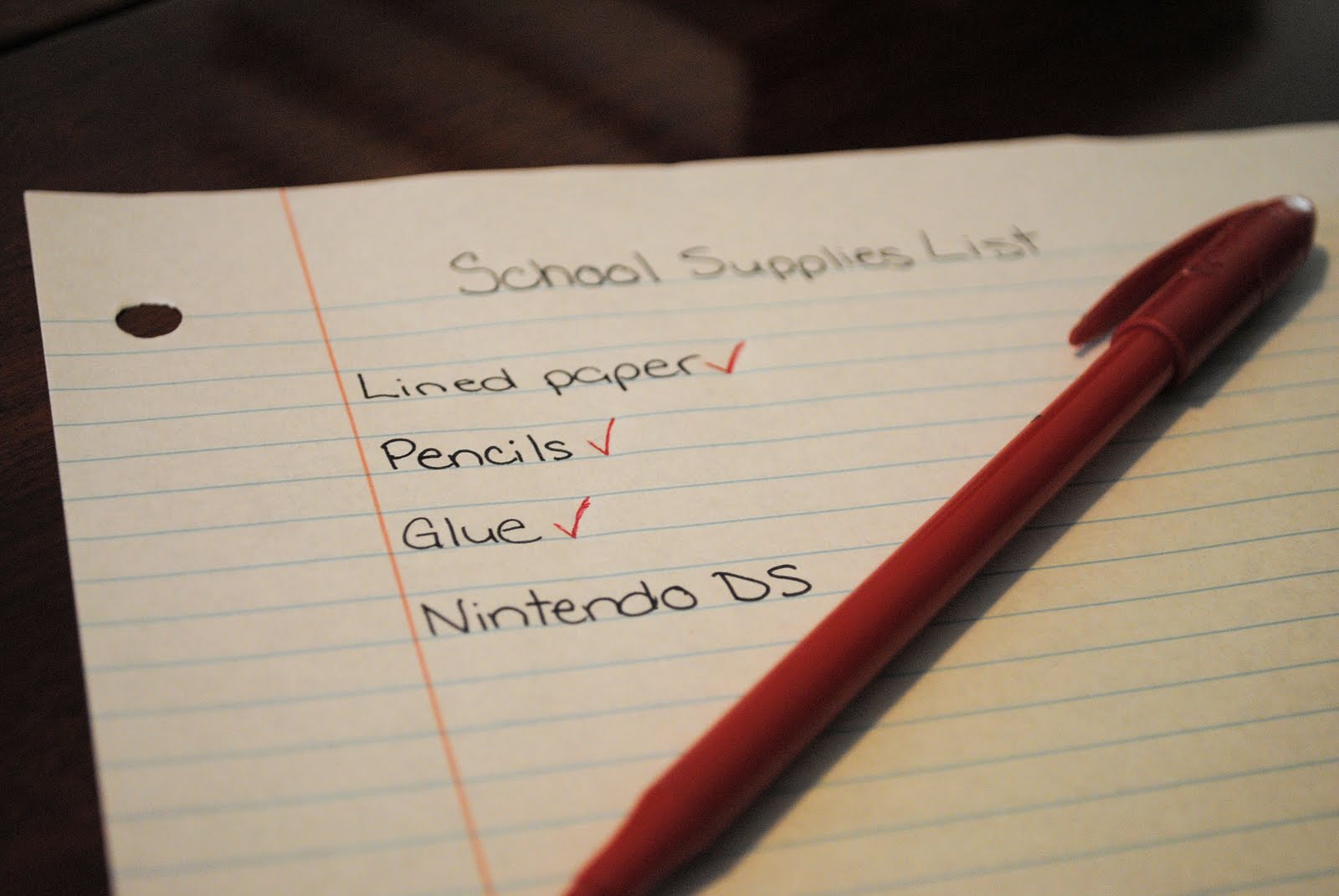
I was observing a committee on special education (CSE) meeting the other day, waiting for a parent to show up – turns out she thought the meeting was scheduled for 20 minutes later than it was – and the school psychologist blurted out something in passing that, unbeknownst to her, stole my focus for the rest of the meeting.
A few weeks before, she had been called to testify in a court case regarding one of the children in the district. The psychologist arrived at court at 9 a.m., but wasn’t called to testify until 4 p.m.
“Good thing I had my Nintendo,” she said.
The psychologist was referring, of course, to the Nintendo Dual Screen (DS) portable video game system. Armed with a built-in monitor and a “touch screen” located just below, most Nintendo DS games are controlled in part or in whole using a small stylus. Seeing as how the original incarnation of the DS is more than half a decade old at this point, that’s nothing astonishing anymore. But while immersed in the special education setting, an idea popped into my head: What if we used the Nintendo DS as a way for children with physical and other disabilities to build their motor skills? The stylus is held and operated just like a pencil – a skill that could transfer to school work – and in some games, like Brain Age, writing numbers and letters is the key to advancing.
“So what?” you might ask. “A pencil and paper is about $199 cheaper.”
That’s a good point. However, writing letters and numbers over and over again on a sheet of paper is about as entertaining as doing 500 pushups and it’s just as tedious. What DS games can offer today’s learners is motivation: There’s something highly satisfying about moving ahead and being able to measure one’s progress, whether that progress is deeper into the dank and dangerous dungeons of the newest Castlevania game or to new scholastic heights in Big Brain Academy.
Consider this: According to educational theorist James Gee in his book Why Video Games are Good for Your Soul: Pleasure and Learning (2006), as human beings, enjoyment plays a huge role in our learning. “Learning is a deep human need, like eating and mating,” he said. “So the real paradox is not that pleasure and learning go together, but, rather, how and why school manages to separate them” (p. 29).
Using DS games, then, could be one of the steps to reconnecting schools with the pleasure of learning. For students who find learning difficult – like possibly children with motor skill or other disabilities – an education that includes a little Nintendo DS learning fun might be just the thing to help invigorate their scholastic careers.
As my CSE meeting wore on, the parent now on her way, I also wondered if the educational applications of the Nintendo DS aren’t limited to special education learners. What about other types of students?
According to a July 11, 2007 article in the Wall Street Journal entitled
“Beyond Pokemon: Nintendo DS Goes to School in Japan” by Yukari Iwatani Kane, the DS has been helping English as a second language (ESL) students increase their grasp of the English language. As students write English words like “tree” and “woman” on their school-supplied DS systems, an electronic voice calls out “Cool!” if the student writes the word correctly or “Come on!” if he or she makes a mistake.
“Work sheets were such a pain,” said Minori Yamanaka, a 13-year-old student at Otokoyama Higashi Junior High School. “These exercises feel like a game” (Kane, 2007).

But it’s not just Japan that’s utilizing the Nintendo DS for educational purposes, and it’s not just for language acquisition: According to an article by Lousie Holden in the
Irish Times entitled
"How Nintendo Can Boot Your Child's Perfomance in Maths," published Nov. 10, 2009, at least two schools in Ireland are using the Nintendo DS to teach math skills to their middle school students. The results, she said, are encouraging.
“Three classes spent approximately 15 minutes a day using two games, Maths Training and Brain Training,” wrote Holden. “All three classes in each grade were given mathematical tests (Drumcondra tests) before and after the trial period. The results of the Drumcondra tests were as follows: In 6th-class maths, relative to their peers, the Nintendo group scored substantially better. Gains were ‘obvious and significant’” (Holden, 2009).
So if the DS really aids in grasping the English language with students in Japan, why couldn’t it work with ESL students anywhere? And if Japanese and Irish schools are already implementing the Nintendo DS in their classes with educational success as Kane and Holden point out in their articles, why not in American special and general education classrooms as well, with software specifically designed to achieve maximum educational benefits?
It comes down to a lack of time for teacher training and wide scale implementation of the DS devices, the stigma that Nintendo products are for entertainment only and, of course, a lack of cash for the hardware and software.
“There is definitely support for the idea, but whether we can get money for it at this time is questionable,” pointed out Robbie O’Leary, principal of Sacred Heart Senior National School in Killinarden, Tallaght (Holden, 2009). O’Leary’s remarks no doubt echo the concerns of other educators in schools across the globe.
Back at my CSE meeting, an overwhelmed mother was relieved as a set of important services for her child were put into place. As I left the meeting, I too was a bit overwhelmed, my mind abuzz with educational possibilities and problems of Nintendo’s popular portable.