Thursday, October 22, 2015

An Assassin’s Creed Retrospective, Part II: The United States of Assassination

Assassin’s Creed: Syndicate, releasing tomorrow, October 23, 2015, is the latest in Ubisoft’s series about men in white robes committing atrocities in the name of the greater good (kind of like Christianity or Col. Sanders).

Syndicate promises to be the biggest and the best, or at least the buggiest, Assassin’s Creed yet. However, it owes much of its splendor to its long line of predecessors.

Last time, we met and promptly hated Altiar, the grandfather of the Assassin’s Creed cash cow; fell in love with Renaissance Italy; and enjoyed another fun-but familiar outing with prettyboy civilian turned prettyboy assassin Ezio Auditore.

And now, after a quick stop in the Middle East – or is it Europe? – we’re off to the land of baseball, apple pie, and petty lawsuits.


Assassin’s Creed: Revelations. Release Date: 11/2011. Available on Xbox 360, PlayStation 3, and PC


Ezio’s finale takes him to Istanbul, known at the time as Constantinople. (Even old New York was once New Amsterdam, I suppose. Why they changed it, I can’t say.) After Brotherhood’s copy ‘n’ paste presentation, this change of locale is not only welcome, but wise: Another romp through Italy would almost certainly have had players crying foul.

The series’ already impressive visuals get a noticeable upgrade here. Constantinople looks wonderfully realistic, though eerily reminiscent of the first Assassin’s Creed, and Ezio’s character model is more detailed as well. As the storyline focuses on his final years, he’s been suitably aged, complete with badass grey beard.

Almost everything has been improved over previous titles, but sadly, Revelations suffers from series fatigue. We’ve been here and done all of this before, and by now, Ezio’s welcome as the protagonist is nearly worn out. About the only thing new is a claw that helps Ezio climb. There’s also a lot of emphasis on the overcomplicated bomb building mechanic, but there’s little reason to tinker with it. Bombs are best left ignored, or better yet, just sell the collected components for a tidy profit.

Revelations isn’t a bad game, but it’s a far cry from the excellence of Ezio’s game of origin, Assassin’s Creed II. If this hadn’t been called Assassin’s Creed, it would have gotten lukewarm reviews, been reduced to $20 within six months of release, and faded into obscurity.


Assassin’s Creed III. Release Date: 10/2012. Available on Xbox 360, PS3, PC and Wii U
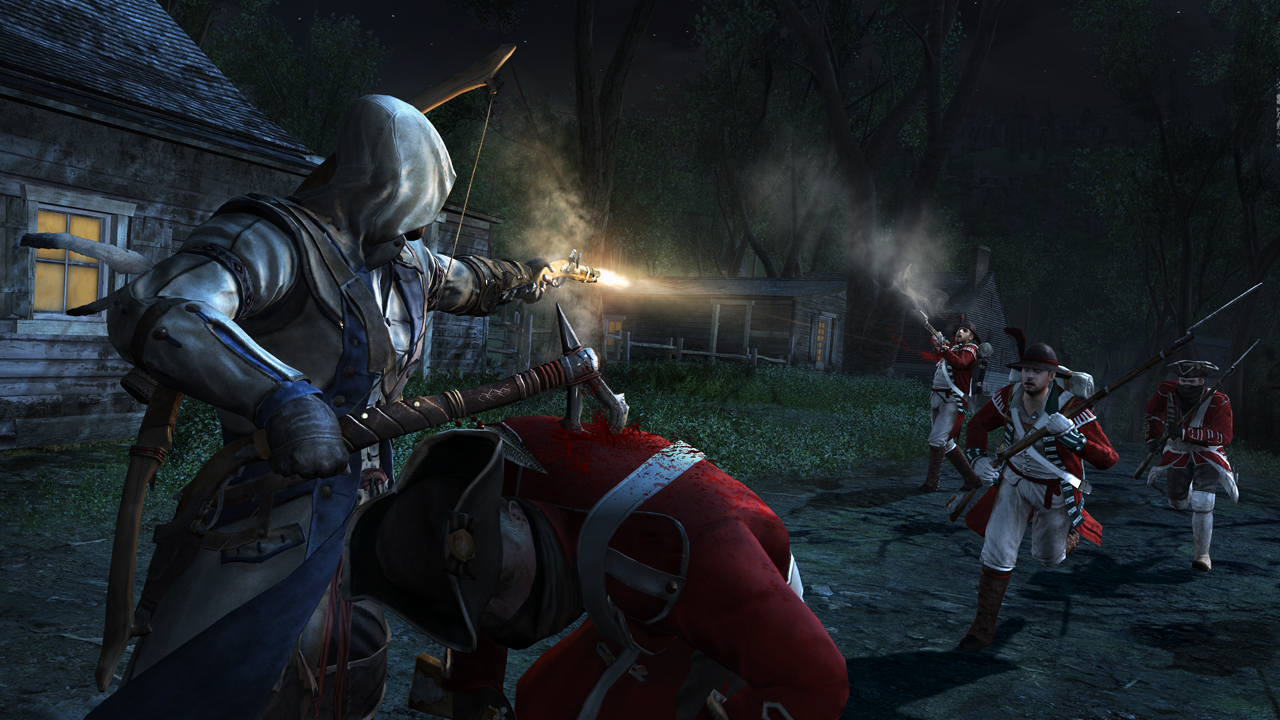

Welcome to Revolutionary War America, where legendary heroes battle for independence from the tyrannical Englishmen while simultaneously owning slaves and pushing Native Americans off their sacred lands.

Although we see a lot of George Washington, Samuel Adams, and even Ben Franklin, the plight of the Native Americans is a major focus of Assassin’s Creed III. But instead of taking the role of assassin Ratonhnhaké:ton (which translated, means “Man with Unpronounceable Name”), we are first treated to six unbearably linear hours with his asshole father, Haytham Kenway. Though it wasn’t nearly as mentally scarring as the first Assassin’s Creed game, I was terminally bored until Ratonhnhaké:ton’s new adopted dad renamed him Connor and gave him a sweet pair of stabbies.

When the game finally opened up, I was treated to one of the most enjoyable settings ever to grace the Assassin’s Creed universe. Connor causes havoc in places I’ve actually set foot in like Boston, and even my home state, New York. Not only that, but the player gets to relive historic events like the Boston Tea Party and the midnight ride of Paul Revere. Having a basic knowledge of American history really brought this game to life for me.

The game looks awesome too. Snow shimmers, near-PS4 quality lighting effects make for awesome sunsets, and I could almost imagine myself sailing over the lively oceans.

Speaking of sailing, Assassin’s Creed III introduces seafaring missions that are fun, but entirely disjoined from the main action. Naval combat would become the focus of the next numbered game in the series, Assassin’s Creed IV: Black Flag. But here in its infancy, it’s little more than an entertaining diversion.

Finally, ACIII wraps up the story of Desmond Miles, whom I’ve been avoiding up to this point because he’s a twit. You see, Desmond has been reliving all of these assassin adventures via a computer that can read his ancestor’s DNA. You know, because memories are in DNA, not your freaking brain. Anyway, Desmond and his forgettable team always have some silly reason to look back in the past, like trying to find some artifact no player cares about.

Desmond sections love to pop up just when the main storyline is getting interesting, grinding the fun to a halt so our favorite bartender-turned-assassin can climb some walls or read a work email. Apparently the world is ending because an ancient race of jerks something something, but seriously, it’s so mind-numbing and out-of-place I hardly cared. Five games after his introduction, Desmond is FINALLY given a pair of blades and sent into battle, but at that point, it was too little, too stupid. Then he touches a cosmic nightlight and evaporates.

Uh, spoiler alert.

But despite Desmond and six hours of initial blasé, Assassin’s Creed III is one of the most memorable entries in the series.


Assassin’s Creed III: The Tyranny of King Washington. Release Date: Episode 1 - 2/2013; Episode 2 – 3/2013; Episode 3 – 4/2013. Available on Xbox 360, PS3, PC and Wii U


Played back-to-back as a single experience, The Tyranny of King Washington packs enough content – about 10 hours – to be considered its own game. It’s fun overall, but at nearly $30 total for all three parts, it’s difficult to recommend to all but the most dedicated of assassins.

The Tyranny of King Washington takes place in an alternate timeline where Connor Kenway, ACIII protagonist and snappy dresser, never took up the Assassin cause. But all is not well, for Connor’s mother has brought the wrath of the evil George Washington, now King of America, on their small Native American village.

From locales to combat, about 90 percent of this game is recycled from Assassin’s Creed III. But oddly for an Assassin’s title, the storyline is one of its greatest strengths. Seeing a world where the iconic George Washington has gone mad with power, albeit for an eye-rolling reason, is enough to make you want to finish this title.

But the real stars of the show are the new animal powers, which allow the player inhuman stealth, mobility, and strength at the cost of Connor’s life gauge. Though almost too supernatural for even an Assassin’s Creed title, they add a whole new dimension to the aging AC formula. You’ve still got repetitive side missions and disappointing collectables around every corner, but with a more focused narrative and less fat than a traditional Creed title, it’s less noticeable.

Also you turn into f**king bear. Sweet.

####


Tune in next time for a detour though New Orleans before taking to the high seas.

Wednesday, October 21, 2015

An Assassin’s Creed Retrospective, Part I: From Frustrating to Fantastic

I was pretty late to the Assassin’s Creed party (where, were it a real shindig, everyone would be embarrassed that they wore the same color).  I’m not sure how I missed one of the bestselling franchises of the last console generation: it’s arguably the biggest yearly game series outside of Call of Duty and Madden. I guess I was too busy with classics like Lair and Duke Nukem Forever: Balls of Steel Edition to notice.

My first experience with the warriors in white was at the end of 2014 when I played through the fourth AC installment, Black Flag, on Xbox One. Capt. Kenway’s questionable adventure on the high – and probably drunk – seas lured me into the world of secret bloodshed, vast conspiracy, and infuriating climbing controls. Over the last year I’ve done a good job catching up.

And now I love to stab almost as much as David Rosen.


On the eve of Ubisoft’s latest yearly cash grab release, Assassin’s Creed: Syndicate, I find myself reminiscing about Ghosts of Stab-mas past. (For those wondering Stab-mas was pretty much every Saturday night for the last few months.) So without further padding, here’s the beginning of a multipart Assassin’s Creed retrospective that none of you asked for, but are still miraculously reading.

Also it’s Back to the Future Day, so TIME TRAVEL and 88 MILES PER HOUR and MARTY and all that jazz.

Assassin’s Creed. Release Date: 11/2007. Available on Xbox 360, PlayStation 3, and PC


Imagine Grand Theft Auto. Now take away everything fun and pay a homeless person to beat you, repeatedly and repeatedly, about the face and neck. That’s the first Assassin’s Creed in a nutshell. I seriously have no idea how there was a sequel after this cosmic train wreck.

My first thought on booting AC1 up was how good it looked, even nearly a decade after it hit store shelves. But the more I played, the more its flaws started chipping away at my enjoyment. Repetitive, pointless missions flood the original AC landscape, and instead of being able to skip them like in future installments of the series, the player is forced to slog through.

Meanwhile, the slightest deviation from what the game wants you to do sends an endless stream of bloodthirsty soldiers your way and you’re forced to kill them all by mashing the attack button. I often had upwards of 20 bodies littered around me just because I brushed up against on guard on my way to yet another pointless mission.

The story is like watching paint dry in the dark, and the main charter, Altiar, is a total asshole.

No video game has made me as hostile, as irrationally enraged as this war crime disguised as interactive entertainment. But aside from the PTSD, this game is great! And by great, I mean one of the worst 100 video games I’ve ever played. Thank God I didn’t start the series with this game, or this would have been an awfully short retrospective.


Assassin’s Creed II. Release Date: 11/2009. Available on Xbox 360, PlayStation 3, PC and MAC


Perhaps unwisely, I loaded up Assassin’s Creed II only moments after finishing the first game. But what could have ended in me taking my own leap of faith in front of a beer truck turned out to be a delightful romp through Renaissance Italy.

I knew in the first five minutes that Assassin’s Creed II was the polar opposite of its older, soul-crushing brother. Everything I hated about the original Assassin’s Creed, everything that made me what to slap Ubisoft in their firehoses (or lady schlongs), one and all, was gone forever.

Taking up the mantle of assassin this time around is Ezio Auditore da Firenze, a carefree young man whose family is clichéd to death. Frankly, it’s been done. But it’s not the story that kept me coming back to Assassin’s Creed II, it was the high-flying, back-stabbing gameplay. Climbing and jumping control was improved, most objectives felt like they mattered, and the most boring side quests were entirely optional.

Also, you can punch the living snot out of townspeople all you want, tossing their bodies in the ocean or, better yet, hiding them in haystacks for a trophy/achievement. I’m not sure how a face-punching, day walking psychopath somehow went unrecorded by Italian history, but I’m sure this game is entirely accurate in his portrayal.


Assassin’s Creed: Brotherhood. Release Date: 11/2010. Available on Xbox 360, PlayStation 3, PC and MAC


Brotherhood marks the transition of Assassin’s Creed into a yearly release schedule, and boy does it show. Recycling locations, weapons, fighting styles, and even the main character of ACII, Brotherhood plays more like an expansion pack than its own title.

I’m fine with that. I consider Assassin’s Creed II one of the best 100 games of all time, so getting more of it was welcome.

I’d love to say more about the plot, but it’s so convoluted and inconsequential that it’s not worth talking about. Just know that Ezio’s charm keeps the player interested, if only to see how he grows as an assassin and as a person.

Thankfully, Ubisoft realized that they couldn’t just give players the same game yet again, and the next entry in the series takes Ezio to the Middle East to close out his three-game story arc.

####


In the next part of this retrospective, I’ll cover Ezio’s last chapter and the series’ expedition to North America.  

Tuesday, September 22, 2015

PlayStation Memories: An Epilogue

On September 9, 2015, Sony celebrated the 20th anniversary of the PlayStation’s North American release, and I shared a pair of vignettes detailing my earliest memories of the console.

Since receiving a PlayStation on Christmas Day 1995, I’ve amassed plenty of PSX stories. After all, the console would redefine who I was as a gamer and greatly influence who I am as a person today. But I’ll save that for another time.

Right now, let’s bring things full circle with my newest (and likely last) PlayStation Memory.

Crime and PlayStation Punishment

October 2009.

I had just quit my newspaper job of five years to complete a Master’s degree and was living with Mom and Dad. But no job and only a pair classes meant two things:

-          I did fantastic work that semester
-          I had a boatload of free time

But student teaching, which I knew would be only slightly less stressful than Vietnam, loomed on the horizon. So Matt, who had never been very good at growing up anyway, sought solace in the past.

"This is a PlayStation black disc."
- Alucard, Castlevania: Symphony of the Night

A chill crept in through my open window, bringing with it the scents of autumn and the stillness of midnight in suburban America. My computer monitor lit up the room.

I had just discovered that I could trick my PSone, the smaller, redesigned version of the original PlayStation, into thinking that the CD tray was always closed. Now I could finally try that disc swapping trick I had heard of when I was a kid.

In other words, I could play pirated games.

That same October night, I discovered that there was a fourth Battle Arena Toshinden and a third Jumping Flash!, both unreleased in North America. Sure the Toshinden series had become a joke and Jumping Flash! hadn’t been relevant since 1996, but I was blinded by nostalgia.  

My first PlayStation came with a demo disc of awesome first-gen games. I spent hours fighting the same two characters in Battle Arena Toshinden while rocking out to the crazy soundtrack. And I think Jumping Flash! was the first truly 3D action game I had ever played.

The next day, I sat in my parent’s living room keeping our new puppy company and tinkering around with illegal backups of Toshinden Subaru and Robbit Mon Dieu, as Japan had chosen to call Jumping Flash! 3. I always get a sort of strange pleasure playing canceled games, betas, and imports, and that day I was riding high on bootlegged glee.

A knock at my door startled me back to reality. Hardly anyone but FedEx would have a reason to come to my house.

I hurried down the stairs. A man in a black suit stood before me.

“Hello?” I asked.

He greeted me and told me his name. Then, “I’m a police officer.” He flashed his badge at me. The zany, pirated Robbit Mon Dieu music bopped away upstairs. And if I could hear it, so did he.

Well, they had found me.

This was not the first time video games had gotten me in trouble. Once in second grade a girl stole my GameBoy. If I hadn’t had the sound turned all the way up, the teacher wouldn’t have heard the startup chime and I’d have played with portable power no more. And in eight grade, I was once so absorbed in an article about Street Fighter EX coming to PlayStation, I forgot to stand for the pledge of allegiance. Teachers can get really bent out of shape about that.

And now I was going to be arrested for pirating decade old Japanese software. I briefly considered blaming the puppy, but his cuteness was an impenetrable shield.

“I’d like to ask you a few questions about the day of August 19,” said the investigator.

“I didn’t download any PlayStation games that day,” I thought.

As it turns out, someone had left a folder full of official, sealed-to-the-public documents just hanging out on my neighbor’s doorstep, and our Man in Black was looking for the culprit. Thankfully, I had an airtight, verifiable alibi for my whereabouts, so he thanked me for my time and started walking to the house across the street.

Relieved, I headed upstairs and booted up Toshinden Saburu. And let me tell you, I’m really, really glad I didn’t go to jail for bootlegging that mind-blowing abomination.

It's as good as it looks.


Friday, September 11, 2015

Opinion: Was revealing SFV’s Rashid on 9-11 insensitive?

Greeting me this morning was the news of another character reveal for the upcoming Street Fighter V. A minute later, I watched as Rashid, a Middle Eastern man who fights with the power of wind, sailed around the screen kicking the hell out of Ryu and sporting eyewear shamelessly ripped from Dragon Ball Z.


Then I remembered that today is September 11, 2015, the 14th anniversary of the terrorist attacks that destroyed both World Trade Center towers and lead to the loss of nearly 3,000 American lives. I didn’t have to look at the comment section to know what people were saying.

But I did anyway. And yeah, some people are really offended.

However, is that a reasonable reaction? Consider the following:

1. The mere existence of Middle Eastern people – and in this case, a video game character of Middle Eastern decent – is not inherently an insult to the people who lost their lives on 9-11-01;

2.    Only a very small percentage of Middle Eastern people are terrorists and associating all of them with terrorism is racist; and

3.  While the events of 9-11-01 were traumatizing for Americans and many others throughout the world, the attacks are no longer part of global consciousness. Capcom is primarily a Japanese company.


What this boils down to is some Americans were devastated (and rightfully so) by the 9-11 attacks and either don’t want to be reminded of them, or have become very sensitive to anything surrounding that day, apparently including this video game character.

And there’s another set of people who are just jerks and will use any excuse to spread bigotry. These are the same kinds of people who hide behind the sanctity of 9-11 and call others “unpatriotic” for pointing out that most Middle Easterners are not jihadists.

That being said, yes, the timing of the announcement could have been better on Capcom’s part, given that America is a major market of the new Street Fighter game. The word “insensitive” popped into my mind, but in light of the first two points on my list, I hesitate to use it.

If anything, Capcom’s marketing team should have known that some Americans would react poorly to the reveal and switched it up with another character. I’m not saying American outrage is justified. I’m saying that business is business.  

Wednesday, September 9, 2015

20 years of PlayStation Memories

Today, September 9, 2015, marks the 20th anniversary the original PlayStation console’s release in North America. Our Japanese counterparts had been introduced to Sony’s grey box about ten months earlier in December 1994, but that just served to elevate the hype here in the States as gaming magazines gave us a glimpse of things to come.


I was going to put together a retrospective of the console that knocked Nintendo and Sega for a loop and revolutionized the gaming industry. But when I think of the PlayStation, what comes to mind isn’t facts and figures, but excitement, promise, and redefining what a video game can be.

Two decades ago, I was on the verge of becoming a teenager. My childhood wonder and enthusiasm had all but faded away. Sony’s PlayStation is the last console that had me truly giddy. It still speaks to the kid I used to be.

I want to capture that and, if only for a few seconds, get you to feel it for yourself. So I give you a pair of vignettes – my own PlayStation memories.


Part 1: Fighting through the Night

September 1995.

About two weeks into my sixth grade year, I got a phone call from my buddy Tom.

“Hey Matt, we rented a PlayStation from Blockbuster Video,” he said. I was vaguely aware of the PSX from reading GamePro magazine.

“Oh? What’s it like?”

He described ESPN Extreme Games, a downhill, skateboard/bicycle racing sort of thing. I was trying to come off as enthusiastic, but I guess it was obvious that I wasn’t into it.

Then, out of the blue: “We also have Street Fighter The Movie: The Game.”

“I’ll be there in ten minutes,” I said.

Street Fighter The Movie was a cross between classic SF gameplay and digitized characters a la Mortal Kombat. The controls sucked. The characters didn’t really look or sound much like their movie counterparts. There was only one new fighter, Capt. Sawada, and his special attack looked like he was pulling his junk out of his pants, earning him the nickname “Dick Whip” (or DW for short).

It was the greatest game I had ever played.

As the night wore on, me, Tom, and a third friend, Ryan, played the same Ryu vs. Chun-Li battle over, and over, and over again. They asked me to stay on as P2, and Tom and Ryan took turns trying be beat me. I might have lost a round here and there, but I never lost a match.

ESPN was more a Tom and Ryan game, so I sat back and watched them try to earn enough money to upgrade their “street luges,” which gets riders as close to the ground as possible before sending them sailing at 80 miles an hour into rocks, trees, and other racers.

While browsing through the options “book” in-game, Tom remarked how the page turning sound effect was super realistic. And you know what? He was right. It was nice touch.

Near the end of the night, Tom opened up the CD drive, pulled out the ESPN disc in the middle of a race, and threw in some dance music CD. Seconds later, we were skating around to a song where two guys kept screaming “Brooklyn boys! Brooklyn boys!” It was really hard to hear what they were saying over the sound effects, though.

“Touch some boys?” Tom asked.

Maybe it was when I finally got Chun-Li’s Super to work, defeating Ryu in a spectacular flash of light. Or maybe it was that silly video of a woman berating your skills when you came in last place in ESPN Extreme Games. But by the end of the night, I knew that Nintendo and Sega had a lot to live up to if they hoped to beat Sony.

And I knew I had to have a PlayStation.


Part 2: Taken with Tekken

December 1995.

Fearing a predicted snowstorm, 12-year-old Matt’s school closes early. As the bus pulls into my neighborhood and opens its doors, I leap out and trot home purposefully. Mom and Dad wouldn’t be home for a few hours.

And I knew where they were hiding the Christmas gifts.

I selected a long, rectangular gift and carefully peeled back the tape at the top corner. Holding it upside down, out slid Tekken for the original PlayStation. The back of the box touted 3D graphics unlike anything I had seen before on a home console. Not even Super Nintendo’s StarFox and the mighty SuperFX chip could render awesome characters and expansive worlds like this!


I tore off the plastic and thumbed through the manual excitedly, noting which character I’d play as first on Christmas morning: Michelle Chang, who I hoped would be like Street Fighter’s Chun-Li. I even listened to a bit of the game’s soundtrack via my Sega CD.

But I stopped short of unwrapping the PlayStation, fearing the wrath of my parents or worse yet, a ho-hum Christmas morning. Tekken slid back into the wrapping rather easily and the tape still stuck.

The rest of the afternoon went by quickly, with me staring out my window, anticipating those 3D battles and waiting for the snowstorm that never came.

Monday, July 27, 2015

Street Fighter V beta takes is cues from SF Alpha

Maybe it was cosmic retribution for seeing "Legend of Chun-Li" in theaters, or maybe I'm just lucky. But while the majority of Street Fighter V beta participants were busy just trying to log into the massively overburdened server this past weekend, I managed to get about two hours play time with the upcoming title in Capcom's flagship series.


First impressions

Graphics: I had hoped that the graphics would be superior to the screenshots and videos I had seen up to this point. They weren't. While a definite step up from the nearly decade-old visuals of SFV's popular predecessor - details like wrinkles in Ryu's gee and the shading on Bison's coat are abundant and appreciated - there's not much to get excited about here. The backgrounds look pretty good, but admittedly, I didn't have much time to admire them if I wanted to win my matches.

Sound: Generic synthpop with some wub-wubs thrown in for good measure. Like Alpha 3, the music gets the job done, but gone are the familiar character themes that we fell in love with in the '90s. I wasn't expecting a sonic masterpiece and I didn't get one, but a few bars of the back alley stage have been stuck in my head since Saturday night. That says something I guess.

Control: It's only slightly different from SFIV - enough to throw off my timing for the first three or four minutes. Honestly, not as smooth as SFIV.


Gameplay

While some players complained that SFIV was too simple for their liking after the complex battle system of Third Strike, the SFIV series eventually sported all sorts of mechanics that pro players could tinker with and use to make gameplay more cerebral: focus attacks, FADC, three Ultra Combo variations, red focus, delayed wake-up, etc.

In comparison, SFV is much more bare bones.

In SFV, the Super Bar works nearly the same as other games, but SFV adds V-Trigger, V-Reversal, and V-Skill. While V-Skill is a "free" move that varies per character and can be used at will, V-Trigger (which powers up your character's specials and sometimes normals) and V-Reversal (essentially Alpha Counter) require bars of V-meter to execute.

And that's really it. Absent is a comeback mechanic like Ultra Combos. It could be argued that V-Trigger is this game's comeback mechanic, but V-Trigger requires skill from the player to utilize correctly, not just a double fireball motion and a prayer.

I think I see what Capcom was doing here: remove the difficult-to-master aspects of SFIV, like focus canceling and Ultras, to simplify the controls. But force matches to boil down more to a player's overall skill. In other words, you'll be dropping far fewer combos, but you also can't count on a lucky Ultra to put you back in the game.

Also, hits have a lot of weight behind them and do a lot of damage, seemingly more than SFIV. Matches are over much more quickly, in the vein of SFII. The game feels a lot more offense-oriented than SFIV.


Character details 

The the beta featured six returning Street Fighters from previous titles (and in Charlie's case, from the grave). I was able to use each character in training mode, but only three characters in matches with other players.

Ryu: Reminiscent of his Third Strike incarnation thanks to his V-skill parry move, Ryu still relies of the same core techniques you've been using since SFII. Denjin hadoken makes a return when Ryu is in V-Trigger mode, but it doesn't seem to have the stun factor it did in Third Strike. V-Trigger specials do A LOT of damage, and should you manage to land crouching HP -> shoryuken -> shinku hadoken, you'll steal more than half you're opponent's lifebar.

Chun-Li: Lighting kick is now quarter circle forward plus kick instead of the traditional mashing on a kick button, which allows for more accurate  twitch combos. EX Lighting Kick might even be more useful than her super (called "Critical Arts" in this game). Also, her jab fireball covers nearly the entire screen now, and its activated with a charge motion, ala SSFII. I used to main Chun-Li in SFII and was disappointed in her under-powered SFIV iteration, but this is quite the return to form. Of the matches I played online, I had the easiest time wining with Chun-Li and went 5-0.

Cammy: Some of her normals are different and her jumping attack animations have been altered - for the worse. Cammy's Critical Art is tough to land, but V-Trigger powers her specials up to do crazy damage. Her V-Skill is her spin-knuckle which can hop behind enemies if done in close, but I don't think it can snuff fireballs like in SSFII. Cammy is still easy to play, but I have a feeling her glory days of SFIV greatness are long gone.


Quick details on the rest of the cast

Birdie seems really strong and is pretty agile for a 500 pound man. He plays a little different from his Alpha series debut, but in a good way.

Charlie has been heavily altered from his Alpha appearances and (if I remember correctly) is no longer a charge character. Lots of potential, but I think his Frankenstein look is just a wee bit over the top.

M. Bison loses his psycho crusher as a special move, just like in the Alpha series, relying now on scissor kick pressure. I spent the least time with the dictator, but I feel that the loss of his excellent heavy kick from SFIV will hurt him in the long run. However, he regains his projectile from the Alpha series, which will up his zoning game.


Overall

I'm not super impressed with SFV as it stands, but the game's got a looooong way to go before it's released. Overall it was fun when I could play it, and I appreciate the direction Capcom wanted to take the series. Whether that will work out in the end, I don't know.

What I DO know is that I really want to get my hands on some more SFV, so Capcom must be doing something right.


Friday, June 5, 2015

Earthbound turned 20, so I wrote this novella

Earthbound, that quirky Super Nintendo RPG most people ignored back in the day but has since earned a cult following, turned 20 years old today.

Earthbound is just about my favorite thing ever - even better than Taco Bell! - and I'm so excited I don't even care that I'm a decaying old man now.

Back in 1995, before smart phones, the internet, Justin Bieber, and light bulbs, 12-year-old Matt couldn't wait to play Earthbound after seeing the great coverage it got in Nintendo Power. And today, I feel the same way.

I wrote the Earthbound Scrapbook in 2010, posting each chapter to this blog separately. To celebrate EB’s 20th anniversary, I collected those posts here into a single novella.


Clocking in at 125 pages of stories and photography that hearken back to the original strategy guide, I view the Earthbound Scrapbook as a companion to your EB play through, or just a fun way for Earthbound enthusiasts to spend an afternoon.

Each entry is from the viewpoint of a different character, ranging from the obvious through the obscure, from the humorous to the poignant – just like Earthbound itself!

Here it is.