Tuesday, August 17, 2010

Old School Gaming Bliss with Scott Pilgrim vs. The World: The Game


I can't tell you how great this game is, especially for all those NES gamers out there who miss classics like Double Dragon and River City Ransom. Actually, I CAN tell you: Head on over to Gaming Life and read my review!

Or, if you're too lazy to click the link, here's the full text:

If you’re old enough or cool enough to remember the hard punching, tire throwing, gut busting NES cult classic River City Ransom, there’s seriously no reason to keep reading this review. Log into PSN and start downloading Scott Pilgrim vs. The World: The Game right now, or barricade yourself in your house until Aug. 25 and get it from Xbox Live. Either way, you’re in for the best 2D arcade experience since Megaman 9 and Super Street Fighter II HD Remix.

Based on a comic I never read and a movie I haven’t seen yet, Scott Pilgrim vs. The World is equal parts side-scrolling fighter and gushy love letter to the 8-bit era. After selecting one of four heroes (and getting flashbacks to Super Mario Bros. 2), it’s the player’s job to pound wave after wave of bad guys into the pavement, a la Final Fight or Streets of Rage, with the ultimate goal of defeating all seven of Scott’s lover’s ex-boyfriends. Up to four people can join the fight at once, watching each other’s backs simultaneously.

There are two attack buttons: The square button initiates a quick flurry of attacks and the triangle button produces a slower and stronger “heavy attack” combo. Special attacks are learned along the way and range from highly useful to barely sufficient. In addition, everything the player finds lying around can be used as a weapon, from baseball bats to plastic buckets, and they can either be thrown at or used to bludgeon nearby baddies. Even enemies themselves can be picked up and used in the same fashion, just the River City Ransom.

And speaking of River City Ransom, Scott Pilgrim vs. The World clearly owes much of its existence to this and many other old school NES games. It may look like a well-drawn PlayStation 1 title, but this download sounds and plays like something straight out of the ‘80s. There’s a secret shop in the first stage in EXACTLY the same area as in River City Ransom, a hit point system reminiscent of Final Fantasy 1 and even a reference to Clash at Demonhead, a bizarre NES platformer lost to the annals of time. The music is half chip tune, half punk rock, with guitar solos and awesome drum riffs that sneak up on you as you progress through the well-designed stages. As a seasoned gamer (read: old man), the title screen music nearly made me cry. I knew the game I was about to play encompasses everything great we’ve had to sacrifice in the name of progress over the last two decades of gaming evolution.

You don’t even have to appreciate old school gaming to enjoy Scott Pilgrim vs. The World: The Game and it’s a steal at the $10 price of admission. With the exception of somewhat slow moving player characters and the occasional control problem, it’s no wonder this game snagged a nod for the “Best Downloadable Game of E3.” There’s no clearer way to say this: I want to have this game’s babies.

Take THAT, the world!

Monday, August 16, 2010

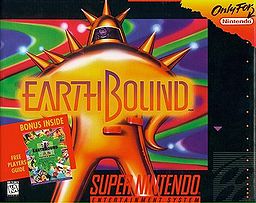
Amber Dreams: Memories of the SNES Classic Earthbound

I’ll never forget the first time I played it. So new, so very different, so distinct. One couldn’t help but fall in love with the wacky characters. Their personalities were as individual and varied as the man who created them. Obviously, I speak of the best RPG, nay, the best *game* ever created: Final Fantasy VI. …Earthbound. I said Earthbound. Final Fantasy VI and Earthbound sound alike, that’s all.

Earthbound has changed my life in countless ways, from giving me a keen mutant healing ability and a nice Adimantium skeleton to helping me achieve the highest level of awareness in every form of martial arts known to man. However, all of that pales in comparison to the minutes of sheer bliss I was plunged into from the second I turned the game on to the instant I got done naming the main character, Ness, “Gargamel.”

But I assure you, even though I found the game too difficult and turned it off relatively early, (“Please select text speed?” Who do they think I am, Superman?) I love the game more than anyone with a second grade reading level or below can fathom. In fact, if Earthbound were a person, I’d kiss her. Or him. Whatever.

Deep in the recesses of my mind, to the left of the frontal lobe and next to the spot I was planning to rent out to microscopic elves as low cost housing, I have a memory. A memory so precious, so vital to my being, that I wouldn’t give it up for all the rice in Pakistan. Even if I was attacked by a Spinnin’ Robo-Ninja Death Squad, I would defend this memory over all else. It is, in fact, the memory of my deceased great uncle. Next to that, in a small cardboard box, is the memory of the first time I played Earthbound.

It was a snowy July day, the 42nd I believe, and I was busy swabbing the decks of my father’s pirate ship, The Free Willy. I never actually knew how to “swab” something, so I basically just covered the floors with some sort of food item, like ketchup, until someone yelled at me and gave me something else to do. Anyway, after discovering that first mates don’t float, my father suggested that perhaps instead of throwing is poorly paid yet strangely loyal crewmen overboard, I could go mow the lawn.

“But Daddy, we’re on a pirate ship,” I protested. “There’s no grass for miles. With the added weight of the lawnmower, I’d just fall off the ship and sink to a watery, yet dementedly comical death.”

“That’s the point, boy,” Dad returned. “But first, I want to you play Earthbound.”

“What?” I stuttered confusedly. “That has nothing to do with mowing the-”

“Just do it, boy. And take Randy Savage with you.”

“Oh yeah!” Savage yelled savagely.

So Randy and I walked into my room and turned on the Super Nintendo, which was easy for us, with all the electricity available on a pirate ship in the middle of the ocean. And there it was, Earthbound. Shigesato Itoi’s vision spilled vibrantly across the glassy screen as I stared in awe. I sat there for hours, basking in its glory. It was grand – profound – beyond anything I had ever seen.

“Do you think we should plug in a controller and actually play the game now?” I inquired after about three days.

“Oh yeah!” Randy affirmatively returned.

So, for the next two minutes or so, Randy and I sat there as the game grilled us like an unfortunate shrimp in an Australian restaurant.

“What’s you’re favorite thing?!” the game demanded, threatening to take hostages if I didn’t answer.

“I… I don’t know!”

“Where were you on the night of December 7th, 1941?!” the game bellowed. “You weren’t, say, bombing Pearl Harbor, where you?”

“I wasn’t even born yet!” I replied. At that point, I handed the controller to Randy and left to get a Coke.

By the time I got back, everyone and everything in the game was named “Oh yeah!” Well, at least we were done with the naming part. So, we began playing, and eventually came upon an enemy.

“You engage the Spiteful Crow,” informed the game. Seconds later, we had beaten it up and stolen its cookie.

“Wow! I must be good at this game. It’s strangely satisfying stealing cookies from defenseless, spiteful wildlife,” I said, grinning.

“Oh yeah!” Savage yelled predictably.

Two steps later, another battle ensued. “You engage the Giygas,” informed the game. “SMAAAAASH!”

“I just lost 22,000,000,000 hit points,” I coughed.

“Oh… yeah…”

At that point, the continue screen pulled up, depicting Ness (or, in my case, “Gargamel”) as an angel. “I see dead people,” I said.

“Oh yeah?”

It was quiet for a moment as he and I stared blankly at the screen. “So, wanna go throw bottle caps at old men?” I finally suggested.

“Oh yeah!” Savage returned.

Well, there you have it; my very first (and very last) encounter with the game that would change my life forever. From its unusual towns to its goofy enemies, Earthbound (probably) delivers unadulterated enjoyment. Who could ever forget characters like that lovable Ness, his dad who’s apparently stuck inside a telephone, that school girl turned super-heroine, Sailor Mo-, er, Paula, that fun lovin’ underdog boxer, Rocky Balboa, or even that wacky “treasure hunter,” Locke Cole?

Earthbound has it all. In fact, the only thing it’s missing is Final Fantasy VI. But, this slight oversight is easily forgivable, given Earthbound’s super-awesome-o-matic game play and its funktastic story line. So, I guess what I’m trying to say is, while Earthbound is a fun game with inserted into a Super Nintendo, it loses much of its charm when inserted into a wall socket.

Congratulation, Earthbound. A winner is you!

Sunday, August 15, 2010

Silent Hill Sunday #2: "Daddy, Help Me! Daddy, Where are You!?"


A lot of video games are simply a fun diversion from the pressures of a stressful existence, but every once in a while, a game comes along that changes the way players look at the world or even the way they live their lives. Street Fighter II brought a host of new words to American lexicon, from the “Hadoken” fireball to the rising “Shoryuken” punch; hundreds of teens across the nation started taking guitar lessons after the advent of the Guitar Hero series (and almost as many kids, to their parents’ dismay, gave up in the first week); and thanks to a little game called Pokémon, obsessive children everywhere have been battling trading card addictions for more than a decade.

In my own experience, something I generally didn’t enjoy before playing the original Silent Hill title for PlayStation was urinating in my pants. However, I’ve taken to wetting myself rather frequently when behind the controls of this game. The first Silent Hill was literally the scariest media experience of my life and I know there are plenty of people who, after they wash the pee out of their trousers, would agree with me. After the horrors of Silent Hill, other “scary” things lose their punch. For example, for SH veterans, The Exorcist might as well have taken place in a McDonald’s ballpit and starred Pee Wee Herman as Fr. Damian.

In Silent Hill, Players take control of mystery author and hopelessly aloof father Harry Mason as he trudges through demon-concealing fog, abandoned amusement parks filled with author-chewing claw creatures, and a lizard-infested sewer that somehow manages to be a reprieve from the action up to that point. The voice acting is horrendous, but that seems to have been a staple in Konami games of the era – just look at Castlevania: Symphony of the Night. Besides, nothing adds to the gut-churning tension of situation like a man delivering his lines with all the bravado of someone trying to decide what condiments to squeeze onto his tuna fish sandwich.

During his pleasant stay in the resort town of Silent Hill, Harry has a hard time searching for his missing daughter, Cheryl, who has short black hair and just turned seven last week. But he has a much easier time finding mighty truckloads of blood splashed on the walls, fleshless bodies hanging in bathroom stalls, thousands of yards of barbed wire and probably a roomful of all the teachers who ever berated you in elementary school, though I have yet to find it. And when the sirens sound, it’s a sign to the player to put down the controller and dash from the room, because things are going to get a whole lot more rusty and stabful in about 20 seconds.

Silent Hill is the typical father loses daughter, father looks for daughter, daughter merges with demonic alter ego and attempts to devour everyone around her kind of story, so there’s really no need to go into plot details since it’s such a cliché narrative. However, whether you’re running from misshapen alien children with sharp, sharp knives; or running from pterodactyls with player-rending talons; or even running from faceless zombie nurses that confuse your neither regions with their unholy mix of sex and death, there is but one thing you must remember: Never trust the Silent Hill manual.

For example, when describing the knife that Harry finds in the first few minutes of the game, the manual says it’s a “weak weapon but better than nothing.” The phrase “better than nothing” implies that one would be better off with the weapon than without it. This is not true. Any fool who attempts to use the knife will find himself flailing wildly, missing every attack and basically offering himself up to the enemy as a sort of well-educated but poorly-spoken flesh meal. Assuming that after months of practice you find a way to actually hit things with the knife, you’ll soon see that your kitchen cutlery inflicts approximately as much damage as a disappointing bedtime story. If it had been up to me, I’d have replaced the knife with an adult toy. It would have been just as effective as a weapon and few can deny the entertainment value of a man battling the forces of evil with a vibrating pseudo-phallus.

The manual also says that the iron pipe weapon is “harder to use” than the knife. Wrong again, manual! Last time I checked, whacking someone with three feet of cold metal is easier than getting close enough to stab them with a dull knife (or an adult toy as the case may be). The same is true in Silent Hill: Killing monsters is better than not killing them and getting your spleen torn out in the process. The more I think about it, the more it looks like the manual wants you to fail.

Let’s see if you were playing attention though taking a quick quiz. Pretend that the Silent Hill manual says that multi-grain fiber bread is an excellent tool for keeping Harry healthy and regular. When you find multi-grain fiber bread in the game, you should:

A. Eat it immediately to restore lost health and/or put an end to irregularity.

B. Toss it at the nearest enemy in hopes of causing damage.

C. Throw it away before it explodes, destroying your television set and blasting shrapnel into your tender eyeballs.

If you picked A, you’re an idiot.

You used the knife, didn't you?

Saturday, August 14, 2010

Spend Saturday the 14th with LJN’s Friday the 13th


Back before Resident Evil, Silent Hill and even Sweet Home were around to give us restless dreams; before Alone in the Dark kept PC gamers up at night; and before terrifying gamers was a good business model; there was Friday the 13th on the NES. It’s not too surprising that this game is actually scarier than the cheesy movies – after all, they were less about genuine scares and more about watching a mentally challenged zombie in a hockey mask off camp counselors in creative and sometimes decorative ways. But this frightful NES game actually puts you in the shoes of an unfortunate group of would-be victims out to destroy Jason – if they can. The other reason it’s so scary is that it’s one of the worst games ever made. It’s frustrating, ugly and boring. And yet, I adore it. Go figure.

Lovingly thrown together in a single afternoon by LJN, the one-time leader in crappy movie-based video games, Friday the 13th is often berated for its repetitive gameplay, unclear objectives and face-melting difficulty. These are all valid criticisms; but what most half-hearted, bash-fest reviewers don’t care to admit is that once you get the hang of things, Friday the 13th for Nintendo becomes a horrifying search-and-destroy mission that’s likely to leave players cowering under their beds in broad daylight.


The story is simple: Jason’s angry and murdering children again, because that’s what he does best, and it’s up to six similarly-dressed camp counselors to rescue the camp’s 54 children and annihilate the man behind the mask. Friday the 13th was the first true survivor horror game: The only goal, aside from trashing Jason, is to make it out alive. Encounters with Jason leave you paranoid because you’re always terrified that he’ll jump out at you in the woods and kill your character. It’s a game of cat and mouse, only the player is never really sure whether they’re the cat or the mouse.


The nine-second tunes that play over and over again in the field, in the cabins and at the character select screen are unnecessarily repetitive even for NES standards. But there’s more than meets the ear going on here: LJN must have spent millions researching how to convert tension into musical form, and the seconds-long riffs that populate the F13 world are the malicious fruit of that labor of hundreds of mad scientists and psychotic dentists. The music is one of the key factors in making Friday the 13th as scary as it is. For those of us who played it as children, this game still provides the soundtrack for our deepest nightmares to this day.


Take on Friday the 13th if you think you can handle it (and its crappy gameplay). Look at it this way, either you’ll defeat Jason, or, to quote the game:


Friday, August 13, 2010

Castlevania HD is a Pain in the Neck


View my thoughts on Konami's newest Castlevania title over at Gaming Life. I'm one of the staff writers there, so for more of my wonderous gaming wisdom, stop by Gaming Life once in a while.

Or, if clicking a link is too hard for you, here's the full text:

I’m doing my best to enjoy Castlevania: Harmony of Despair, Konami’s new Xbox arcade title starring Alucard and a host of other CV Legends, but it looks like Dracula and his minions might win this battle.

Harmony of Despair eschews the “Metroidvania” style of recent Castlevania titles in favor of gameplay that more closely resembles the original level-based NES offerings. Experience points have also bit the dust, so it’s up to the player’s action skills alone to keep them afloat. However, the conventions of games like Symphony of the Night aren’t entirely left behind: The player can upgrade his or her equipment by finding new weapons and armor strewn about the playing field, and consumables, like the series’ trademark cuts of meat, can be carried and used when needed. From one to six players can join in the action via Xbox Live, which proves to be the title’s main draw.

Sadly, there’s really nothing “HD” about this game despite its title. I’m using a 1080p TV and though the game looks good, it’s not exactly eye-popping. The same tired graphics we’ve been seeing since 1997’s PS1 classic Castlevania: Symphony of the Night litter the screen, augmented with enemies nabbed from other Castlevania titles. I’m an old school gamer and a sucker for sprite-based visuals, but there’s nothing retro about graphics we’ve all encountered on our DS consoles as late as 2008’s Castlevania: Order of Ecclesia.

The visual settings are libel to leave you scratching your head as well. The “native” setting allows the player to see the entire level on their TV screen all at once, but it offers a heinously tiny view of your character that’s only playable on the most gargantuan of monitors, like the one in Time Square. Plan on setting the game to at least x2 if you hope to have any fun.

When it comes down to it, were it not for the frantic six-player action, there would be nearly no reason to play C: HD. It’s easier to forgive the game’s flaws when you’re busting demon skulls with five other players, but keep this in mind: Six guys having fun with a flawed game still leaves you with a flawed game once the controllers have been put aside.

Even as a moderate Castlevania freak, it’s difficult for me to recommend purchasing Castlevania: Harmony of Despair. All but the most hardcore Castlevania fans and 2D action junkies will get much mileage out of this one. But don’t do this game a disservice and skip it entirely: Download the demo on Xbox Live and see for yourself if this game is worth sinking your teeth into.

Wednesday, August 11, 2010

The Godfather: The Game - An Entirely Accurate Lesson in History and Culture

I’ve never seen any of the films in the Godfather trilogy, so my knowledge of the franchise is limited to cliché “offer you can’t refuse” imitations of the late Marlin Brando and cheap allusions to the series in the cartoons of my youth: The Godpigeon from Animaniacs comes to mind, as well as the fact that calling him “Godfeather” would have been so much more witty. Furthermore, I don’t know much about Italian culture aside from what the 1989 Super Mario Bros. cartoon taught me, including the crucial fact that every Italian is preoccupied with spaghetti, pizza, meatballs and ravioli to the point of obsession.

So obviously, The Godfather: The Game, Electronic Art’s awkwardly-named sandbox title for Xbox, Xbox 360, PS2, PS3 and Wii, was the perfect choice for my newest gaming excursion – as well as a much-needed lesson in Italian culture.

In The Godfather: The Game, your goal is to change your name to Donald. Currently, there is only one man named Donald: Vito Corleone, often shortened to “Don Corleone.” People are always nice to Donald Corleone because he has a lot of money, kind of like Donald Trump, who must be really good at The Godfather: The Game. Also, the Donald is allowed to talk with his mouth full, which he seems to do at every given opportunity because it’s pretty hard to understand him sometimes. About three quarters through the game, Donald Vito Corleone is tired of being Donald and wants to play with his grandchildren or something – it’s not explained too well – and suddenly, your character has a chance to be the one and only Donald, the Donald of New York City (often just called “The Don of NYC”). I’m not sure how they know that no one else in New York has named their child Donald, but the game is pretty sure there’s only one Donald available at any given time, so who am I to argue?

The only way you can become Donald is through punching and choking a bunch of bakers, bartenders and hotel owners until they give you money, presumably because a prerequisite to being the Donald is to be rich. To do this, you maneuver your character into an establishment that is otherwise peaceful and you find the person who runs the joint. It’s pretty easy to find them because they all wear the same black and white hat that floats three feet above their heads. Also, the layout of every bakery, bar and nightclub is basically the same, because during the Great Depression, around the time when this game is set, people didn’t have enough money to buy different businesses. Instead, they all pooled their money, bought one building, and made illegal copies of it though Napster.

Anyway, when you find the owner, you punch him or her. A lot. The manual calls this part of the game “Blackhand,” but my character’s hands are clearly Caucasian, so I call it “The Lady Punching Part” or just “Dad” for short. After stopping the evil bakers and whatnot, they donate to your Donald fund. Thanks to what I’ve learned about Italian culture so far from the Godfather game, I can only assume that in addition to troths full of pasta sauce and crazed bouts of binging thousands of meatballs, Italian family reunions include patrolling the neighboring streets looking for palette-swapped businesspeople to terrorize, then eat pizza with.


Your enemies, aside from prostitutes and flower shop owners, are other mobsters. The mobsters dressed like normal people yell things like “please don’t kill me” when you attack them and are the wimpiest enemies in the game, but the other mobsters, the ones dressed in blue, green, yellow and red, usually put up more of a fight.

Battling the other mobsters is no easy task, but the real challenge is taking care of all the people who betray you. There are some truly unbelievable double and triple crosses that will have you yelling, “No way!” Or as Super Mario would say, “That’s un-pasta-ble!”

Also, “It’sa me, Mario! Let’sa go!”

In addition to the excellent gameplay, The Godfather: The Game: The Soundtrack is wonderful. The Godfather theme sounds just like it does on my copy of “Mob Hits Vol. 1,” a series of albums aimed at Italians which is not offensive in the least. My only complaint about the soundtrack is that the cops, all of whom are Irish, don’t have their own appropriate theme songs involving the color green. Incidentally, I like store my copy of Mob Hits next to my album of whimsical drinking songs about leprechauns and potato farming called “Lazy Drunken Red-headed Hits.”

Before I end this review, I’d like to thank Electronic Arts and The Godfather: The Game for teaching me all there is to know about Italian culture without resorting to insulting stereotypes or grossly misrepresenting 99 percent of the Italian populous. Thanks EA; you’ve done just as much for Italian culture in the 2000s as the Super Mario cartoon did in the 1980s.

Next week on Wordsmith VG: I learn all there is to know about African American culture by playing DJ Boy on Sega Genesis, studying Barrett from Final Fantasy VII and watching the first season of Goodtimes over and over again. DY-NO-MITE!

Sugar, Flower and a Dash of Earthbound

Plug in the gamepak and feel the smoothness of the controller in your hands as you power up the console. Watch eagerly as Ness and his friends travel to distant places and lost lands in the quest of a lifetime, or just to the burger joint down the street. Close your eyes and listen to the sweet melodies of Earthbound, knowing they will stick with you forever. Find your player's guide and take a good whiff of the scratch n’ sniff cards in the back, associating the unique scents with that unforgettable Earthbound experience. And, uh… lick the cartridge as you put it back in its sleeve, savoring the taste of 15-year-old plastic...? Sorry Earthbound fans, but as much as we adore and revere it, our RPG of choice can’t quite give us the satisfaction of stimulating all five of our senses at the same time.

Or can it?

How, you might wonder, does Earthbound appeal to a player's sense of taste? We’ll get to that, but first, let’s consider the approach that Toe Jam and Earl in Panic on Funkotron for the Sega Genesis took: Included with the game was a tasty Fruit Roll-Up. While it was an awesome surprise at the time, the problem with the Fruit Roll-Up gimmick is that after you eat it, it’s gone for good. Through nearly 70 levels of jammin’ action, Panic on Funkotron never mentions that lone Fruit Roll-Up again. Aside from a life-sustaining cake here or there, the game doesn’t allude to the player’s sense of taste at all, which is a shame, because Big Earl’s sweaty, oversized polka-dot boxer shorts look delicious. Instead of taking a unique theme and running with it, all Sega really did was jam candy in the game’s plastic clamshell and pray that kids would start asking their parents to buy more Fruit Roll-Ups.

However, unlike Toejam and Earl’s sophomore effort, Earthbound takes its snack time seriously. While Nintendo didn’t package mouth-watering candy in the giant box it came in, food is so well integrated into Ness’s world that it’s almost impossible to imagine the game without it. It often seems as if Earthbound has an endless supply of edible wonders, and with a menu of more than 50 items, it might as well. There’s always something exciting to eat in every town, swamp or palace, and the player is constantly winning new and interesting treats from the enemies.

At first one might think it’s strange that a game that sometimes spirals so far from reality would reel itself back in just for the culinary aspects, but take a look at some of the food the player can obtain during the course of the game: Peanut Cheese Bars, trout yogurt, soup made from the fins of a deadly sea monster, and more. Even the “normal” types of food add much to the game’s atmosphere, with pizza parlors, fast food places and fancy-schmancy, over-priced restaurants scattered virtually everywhere in the game.

With tons of wacky meals, each with their own unique healing effects, it’s clear that the programmers went far out of their way to give every food item a personality all its own. Do you remember finding the Plain Roll in your Earthbound travels? The player needs plenty of Brainfood lunches to survive the trek through Deep Darkness and make it to the cave of the elusive Tenda tribe, but once you get there and trade away a valuable Horn of Life, the 24 HP healing power of the Plain Roll will be yours. “Hey, wait a minute!” you may have yelled at this point, wondering why you wasted so much time and effort to get such a useless item. But take a moment to analyze what the programmers really did here: The Plain Roll is a one-time item, meaning you can’t find it anywhere else in the game. The prize isn’t the item itself – it’s obviously completely useless – but the fact the programmers went out of their way to put such an item in the game. Just try not to laugh as you slowly realize the joke the programmers played on you. Then take a few seconds to think about how dedicated the MOTHER 2/Earthbound team is to their craft.

Food even plays a subtle, yet vital roll in the game’s storyline. All I need to do is say “Tendakraut” and seasoned Earthbounders will smile at the thought of the stinky delicacy that allows access a village forgotten by time. Don’t forget about the snack that whisks our heroes’ minds away to a far away land, the hungry miner in Dusty Dunes Desert, or the coffee break in Saturn Valley. And what about the disgruntled Mach Pizza employee who delivers the Zombie Paper that becomes the salvation of an entire eerie town? Try as I may, I can’t think of any other game that can say pizza helped save its universe.

Shigesato Itoi, creator of the Mother/Earthbound series, strives for excellence in everything he does, from journalism to making video games. With MOTHER 2/Earthbound, he and his team set out to make something that would appeal to players not only as a video game, but on a deeper, more human level. Food is an indelible part of life in all cultures, and knowing this, Itoi found a most creative way to integrate it into his game. Earthbound proves not only can a video game appeal to sight, hearing, touch and even smell, but also that a hunk of plastic and circuits can indeed appeal to one’s sense of taste as well; and Itoi didn’t even need a Fruit Roll-Up to do it.

I guess you really can have your Magic Cake and eat it to.