Showing posts with label Mega CD. Show all posts

Monday, June 20, 2011

Another Sizzlin' Sega Summer

For about the last 12 years - starting right after the death of the 16-bit era and the rise of 3D capable 32-bit systems like Sony's PlayStation and Sega's Saturn - the soothing, searing heat of the summer brings with it my renewed obsession with Sega's Genesis/Mega Drive and its many failed add-ons. During summers past, I've found myself playing through the Phantasy Star series one year at a time; immersing myself in mediocrity with the likes of Cosmic Carnage, the lazer-blasting humming bird Kolibri, and the forgettable "action" RPG Sword of Vermilion; and basking in the warm glow of the Sega CD/Mega CD's many, many full motion video games. Perhaps my greatest pro-Sega project spanned the length of four summers: I created back-ups of the entire North American Sega CD catalogue, spanning about 250 CD-Rs. The madness even included Bug Blasters, Citizen X and all the other nostalgic crap Good Deal Games resurrected in the early and mid-2000s.

Middle: My Sega CD back-up collection.
Top Left: Some Good Deal Games releases.

This summer greets me with limited access to my collection thanks my clever cousin taking up temporary residence in the "Sega room" and my preoccupation with finding a more suitable job. (By the way, did you know that a Master's degree will get you 50 cents more an hour at Best Buy than a Bachelor's? THANK GOD FOR ALL THAT COURSE WORK I DID.) But despite these factors - and my best judgement - I've got Sega on the brain yet again. You can thank the PlayStation Network re-re-re-re-re-re-re-re-re-re-re-re-re-re-re-release of Sonic the Hedgehog 2 for getting this little gem stuck in my head for the 6000th time in my life:


In case you've never experienced it, that's theme of the Hidden Palace Zone, the most publicized of myriad cancelled levels in Sonic’s second adventure. I used to sit and listen to this song in Sonic 2's sound test for hours on those lazy summer days, thinking about the "zone that never was." I’d seen a few pictures of a shimmering underground world, mysterious and alluring. What could it have been like? Why was it cut out of the game? Would it ever be finished on the Sega CD?

I guess I was the introspective type even at 10 years old.

Outrun!
This year, my cousin and I recently raged our way through the streets in Sega’s seminal Streets of Rage 2, bringin’ back memories of ass-kickings of old; seeing the manual to Altered Beast right now is making me want to travel back in time and "Wize from [my] Graweve," and I'd like nothing more than to jam out in the nearest graveyard with the killer robot version of Michael Jackson in Moonwalker. As the sun sets over the lush trees in my quiet neighborhood and the birds tweet their greeting to the coming summer season, I know there are epic battles yet to be fought in Eternal Champions: Challenge from the Dark Side, freaky buttons to be pushed and madcap consequences left to pay in Panic! and a plethora of cross country races left to win in Outrun.

I've never understood what it is about warm weather and the sweet scent of 10,000 flowers pouring gently through my window that gets me revved up about Sega's little black box and its uninspired upgrades, but like clockwork every year, the house that Sonic built takes center stage in my gaming world. This summer, grab a cool drink, take up the mighty 3-button controller and  find out for yourself just why the Sega Genesis once again does what Nintendon’t.


Long live Sega's 16-bit battles and the sun's spectacular rays!

Thursday, October 14, 2010

Potentially Frightening Halloween Games: Hysteria Project


It’s been a long time since Sega took on the Nintendo juggernaut and, for a fleeting while, was beating the Home of The Plumbers at its own game. However, it wasn’t enough for Sega to simply win; they wanted to obliterate the Big N and capture the love and money of the gaming masses. But greed and hubris often lead to bad decisions, and the Sega of the mid-‘90s was chockfull of them.

The poor judgments and marketing missteps all began with something that had boundless potential when it was first released to American audiences in October of 1992: The Sega CD, also known as the Mega CD in Europe and Japan. Instead of crafting expanded worlds or delivering fresh, exciting experiences to hungry gamers, Sega focused on “full motion video” games, which were supposed to be like playing a movie; yet they were little more than exercises in timed button presses and choosing an action at random, then watching the results play out in grainy, postage-stamp sized video.

The FMV “craze” petered out nearly as quickly as it started, but producers like Digital Pictures – with plenty of games still in the pipeline – kept shoveling more FMV titles on an already saturated market. Sega CD became typecast as an FMV machine and died a slow death, breathing its last in early 1996 and virtually taking the FMV genre with it.

This... looks frighteningly like an FMV game title screen.

I say “virtually” because earlier this year, Sanuk Games unleashed the PSN and iPod/iPhone title Hysteria Project, giving longtime gamers flashbacks to how those tear stains appeared on the manuals of so many of their Sega CDs. Apparently the men and women of Sanuk Games have never heard of FMV clunkers like Ground Zero Texas, Supreme Warrior, and the granddaddy of them all, Night Trap, as evidenced by their description of the game: “Recommended for fans of new experiences and thrill-seekers.”

If by “new experiences” they mean the same repetitive, frustrating dreck I pumped hundreds of hours into through middle school and even high school when I was feeling an odd combination of nostalgia and masochism, then yes, Hysteria Project is a new experience.

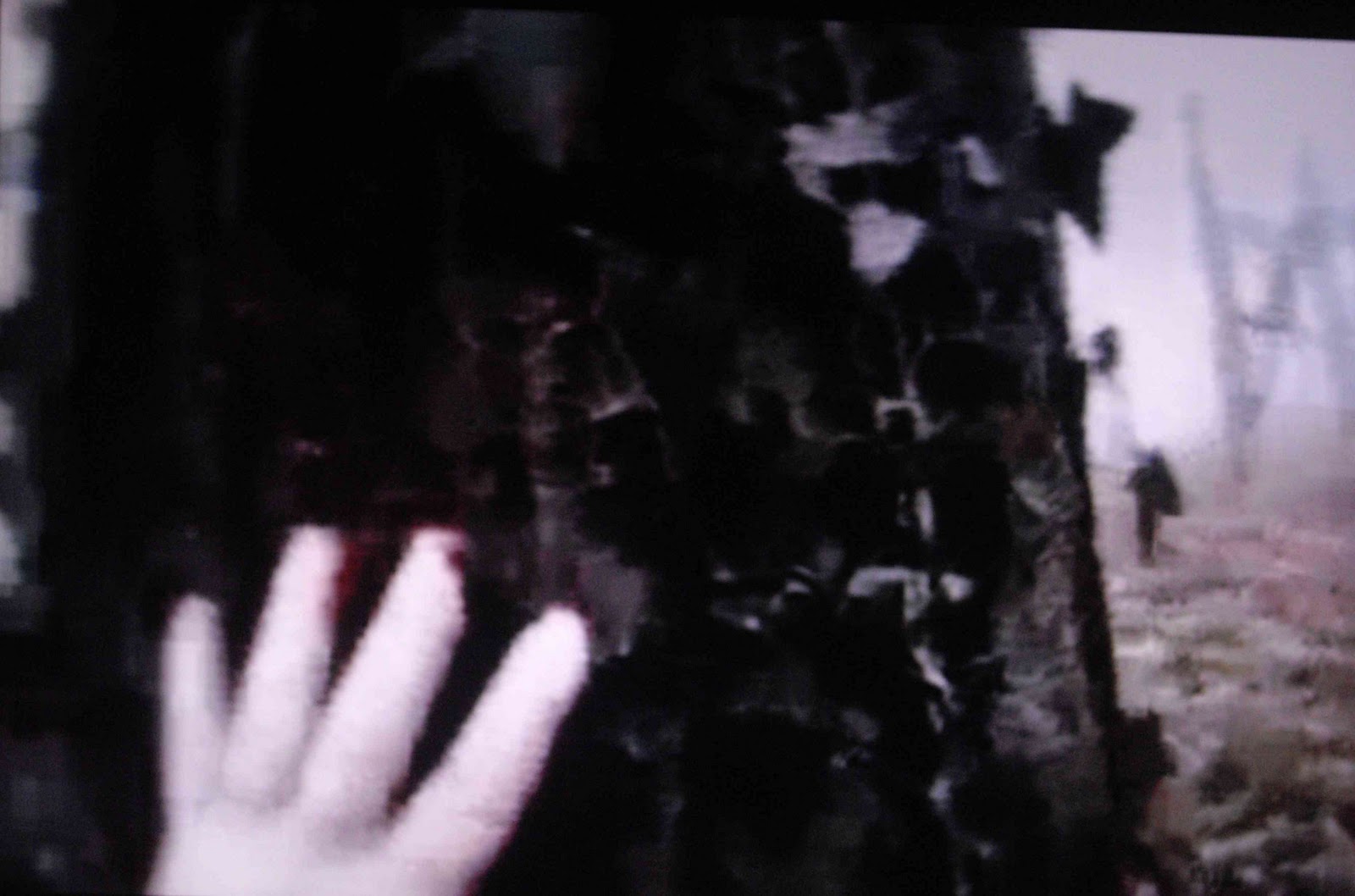
Despite what this looks like, I didn't drop my camera in the woods and accidentally take a picture.
This is an actual Hysteria Project screen shot.

Your character begins in someone’s shed, inconveniently built in a desolate forest about 90 miles from his home. Our nameless flannel-wearing hero, who I’ve dubbed “Untitled,” has been bound at the hands and feet with duct tape by a man in a black hoodie who is never without an axe; I guess he must be a lumberjack or something. Then the pixilated video stops playing for a moment, giving you a Choose Your Own Adventure style set of options: Either try to remove the tape or look around the cabin. Once you make your choice, a few more seconds of YouTube-quality video show the outcome.

"If you think Untitled should search the pile of leaves, turn to page 72."

Eventually, Untitled escapes from the shed and right into unused footage from The Blair Witch Project. Like Jason Voorhees, The Lumberjack can teleport at will and is always behind or in front of Untitled, causing him to shake his camera like a freshman video student. You’ll spend the majority of your time prancing about the woods, avoiding The Lumberjack because he has a habit of mistaking you for firewood. If Untitled does something stupid and gets himself whacked, you can retry as many times as you need – at the cost of overdosing on the movie clip that comes right before where you lost. Sometimes you’ll be required to make a few timed button presses, just like the 1994 Mighty Morphin’ Power Rangers game on Sega CD. It is a thrilling new experience.


Disembodied hands = 80 percent of Hysteria Project.

And that’s the entire game. I literally finished it in less than half an hour, which makes the beginning screen that warns players to take a break after every hour of play kind of unnecessary. Considering Hysteria Project is labeled as a “PlayStation Mini” on PSN and cost me a grand total of $2.15 after tax, I wasn’t really expecting an epic along the lines of Final Fantasy XII, Dragon Warrior VII or David Robinson’s Supreme Court. But what’s inexcusable is that the game ends smack-dab in the middle of the action with a “to be continued” substituted for actually gameplay. There’s no indication anywhere in the description that what I purchased is not a full game or is episodic in nature.

I liked this game better when it was called Wirehead. At least there was a touch of primitive humor and a boatload of variety. Wiredhead begins in a house and can wind up with the main character skateboarding down a rural main street, hopping on an airplane, or even wrestling a grizzly bear. It sucked, but it sucked with a few ounces of charm.

It wouldn’t be fair of me to rake Hysteria Project over the blazing hot coals of gaming ire without pointing out that it features some appropriately atmospheric music and a genuine-if-mild sense of dread for the first two minutes of Untitled’s mad dash to freedom. Ironically, the game’s bite-sized scares can be attributed to the fact that it’s an FMV game and, therefore, the player has almost no control over the action. Just like in a Michael Myers flick, all you can do is watch helplessly as the guy on screen gets stalked and slaughtered. But unlike the movies, in Hysteria Project, you’re the one to blame. (Although I could go into a tirade about how movies wouldn’t exist if there was no one paying to see them – supply and demand and all the jazz – so it sort of is the viewer’s fault in a way. But that’s for another day.)

I'm waiting for Untitled to turn the camera on himself and start talking about how he's "so scared."

When I’m making a sale at AMERICA’S NUMBER ONE ELECTRONICS DEALER, Best Buy®, instead of a boring job like teaching English to students in 7th to 12th grade or reporting on local theater, I always like to throw in the fact that I’m not getting commission. It helps to gain a customer’s TRUST. By that token, I think now’s a good time to tell you that I love the Sega CD console, even the crappy FMV games. But that’s only because it was a snapshot of a burgeoning industry and a monument to Sega’s overconfidence and laziness at that time. Playing an FMV title on anything but my trusty/rusty Sega CD is kind of like a Nightmare on Elm Street movie starring Richard Simmons; no one goes to see a Nightmare flick for anything but the Bastard Child of a Thousand Maniacs himself, Mr. Krueger. Otherwise you get an empty experience that makes you yearn for the comfortable mediocrity you’ve come to expect.

"He's inside of me, Grady!"
In a way, one might trace Sega’s decade-plus long woes back to its reliance on FMV games. The Sega CD was the first in a long line of consoles that eroded customer confidence in Sonic the Hedgehog’s headquarters, and full motion video was a major culprit. While I hardly think that one cheap, downloadable FMV game will be enough to bankrupt Sanuk Games, I think the fact that Hysteria Project hasn’t seen its continuation in the six months since its release certainly doesn’t bode well. I can’t recommend this game as a must-play title, but with a price tag of $2, there’s not much to lose if you find that you’d rather be playing strip Uno with your card-counting cheater of a cousin than even thinking of Hysteria Project. The curious should download it, but know that you’re much better off grabbing your FMV fix from Double Switch, Prize Fighter or any of the other 12 million Sega CD titles that are probably just as inexpensive at your local pawn shop.

Wednesday, August 25, 2010

First Original Genesis Title in 12 Years Nearing Release?


Pier Solar, the first original Sega Genesis (Mega Drive) game in more than a decade, might soon be captivating retro gamers in America, Japan and Europe. Read my post at Gaming Life for more details. I must say, I'm excited!

Or if links scare you, here's the full text:

Pier Solar, the first original Sega Genesis\Mega Drive game coded from scratch in at least a decade, is apparently nearing release.

About two years after Water Melon Development, the team behind Pier Solar, began taking preorders, those who reserved the game received an e-mail Monday asking them to confirm their shipping address. Though no official word has come from the game’s developers, the e-mail hints at a release date in the near future.

Pier Solar began life more than five years ago as “Tavern RPG,” a pet project of the Sega fansite, Eidolon’s Inn. What was meant to be a small undertaking blossomed into a full-fledged, 64 MEG role playing game for the Genesis, complete with “asynchronous turn-based battles,” an enhanced CD soundtrack for Sega CD owners, and at least five selectable languages, including English and Japanese.

“We hope all those who purchase Pier Solar will gain the very same feeling of excitement [and] joy they had from playing the Sega Mega Drive/Sega Genesis for the very first time,” write the developers on the Pier Solar web page. “We want people who play Pier Solar to experience the same level of enjoyment and pleasure [that] we did from creating it.”

Though Water Mellon Development stopped taking preorders for Pier Solar last month – they claim that they sold out of the North American, European and Japanese versions of the cartridge – the game may again be made available in small quantities via the Pier Solar website shortly after all reservations are filled.

Pier Solar shares its initials with the Phantasy Star series, which is often considered the premier RPG franchise on the Genesis.

In addition to Pier Solar, two other role playing games have been released for the Sega Genesis in the last five years by the company Super Fighter Team: Beggar Prince in 2006 and Legend of Wukong in 2008. Both games were translations of existing Taiwanese cartridges released in the territory during the Genesis’s heyday in the ‘90s.

Below is a video of Pier Solar in action, including the Genesis cart accessing the Sega CD for the soundtrack:

Tuesday, January 27, 2009

Mortal Mediocrity: MK1 on Sega CD

It's bigger... than the Genesis cartridge.
While Midway Games was programming the Sega CD version of the arcade powerhouse Mortal Kombat, the publisher, Acclaim, promised the result would be "bigger, better, louder and meaner" than any of the other home versions available. What they finally heaped on violence-starved customers was essentially the old Genesis/Mega Drive version with a CD-quality soundtrack.

Soon after making a killing in the arcades, Mortal Kombat was released on several home systems, including the Sega Genesis and Super Nintendo. Both of these ports underwent drastic changes in the process, including audiovisual alterations and downgrades in order to compensate for both of the home systems' limitations. The result was still Mortal Kombat all right, but the Genesis version lacked the visual punch of its big brother, and the graphically-superior SNES version suffered from watered-down violence and stinted controls.

But for the arcade perfectionist, there was a light at the end of the tunnel: The much anticipated Sega CD version was supposed to remedy all the problems of the previous releases and deliver a true arcade experience.

It didn't.

Those who had waited months for the definitive home version of the bloody brawler were sorely disappointed with the final Sega CD product. Instead of emulating the superior graphics of the quarter-cruncher, or even the problematic but pretty Super Nintendo offering, the programmers had simply added a few more frames of animation to the existing Genesis game. It seems like a cheap move, and it was. But thankfully, the reinserted frames turn the stiff, "cardboard cutout" characters of the Genesis version into much more fluid and realistic fighters. Kicks and punches flow much better, and characters bob up and down instead of performing the same three frames of animation indefinitely. Moreover, Sub-zero looks like he did in the arcade, meaning he no longer has to share his fighting stance with his palette swapped rival, Scorpion, in the name of saving ROM space.


It's the same washed out, grainy screen as before.

Unfortunately, the fluid animation doesn't save the graphics from looking grainy and washed out, thanks to the Sega CD's limited color choices and the already lacking Genesis game on which MKCD is based. Johnny Cage's portrait on the character select screen, for example, is a blotchy mess. His teeth are nothing more than a white blob, where as in the arcade version, one could practically count his fillings. Most backgrounds look decent, but some are mysteriously empty (such as the Buddha temple stage). Given the abilities of the Sega CD unit, there is no reason why the graphics couldn't have at least come close to those of the arcade original, yet we're left with a half-hearted hack job that rests somewhere between the Genesis and the SNES ports.

Mercifully, the sound fares much better. The music seems to have been sampled directly from the arcade game and it sets the stage for battle nicely. Foreboding, vaguely Asian tunes compliment the game's dark themes and seedy locales. The fighters grunt and yell during battles, but a few of the screams and groans from the arcade game curiously go missing. The sounds of combat are bland and uninspired, but they get the job done: Generic punching noises accompany every successful hit and a forgettable "wooshing" noise plays whenever a character whiffs a roundhouse kick or takes to the air.

Get over here!
Although there's not much in the way of extra features in the game itself, there is some extra content on the Mortal Kombat CD that can't be found elsewhere. When they first power up the game, players are treated to a grainy video splicing gameplay footage with the old Mortal Kombat TV commercial. (Laughably, the in-game footage is all from the SNES version.) While it's not much on its own, it brings back some fond memories for those of us old enough to remember these infamous ads. Also included are extra songs tacked onto the CD after the normal game music. These tracks are remixes of the now famous Mortal Kombat theme song heard in the intro video, tracks that aren't even on the official Mortal Kombat album! Lastly, the programmers were nice (or lazy) enough to leave the original Genesis cart's "bloodless" fatalities intact in the programming, accessible via a code. While they're all rather shoddy reworkings of existing moves, when you've seen Sub-Zero tear off everyone's head at least 14 million times, it's a fun change of pace.

While the extras on this disc shine, sadly, the actual gameplay doesn't. There are only seven selectable fighters versus the ten or twelve that were common in fighting games of the early 90s, and each character has the same set of basic moves. Ironically, the same uniformity that makes this game so easy to pick up also destroys much of its replay value. What few moves you are in control of are drastically overpowered. Uppercuts send players reeling, foot sweeps can easily be used over and over again to "cheap" your way to victory, and to quote what my friend Ian used to say, "Your jump kick is like a super move." The entire game can be easily conquered with these three attacks alone. There's not much in this game to keep head-to-head fighting freaks battling each other, and even less to keep the solo player interested. Mortal Kombat is fun for a while, but like bouncing on a trampoline, you're eventually going to get a headache from the repetitiveness of it all.

Fatality!
With a six-button controller, it's easy to make the characters do pretty much whatever you want. Impressive uppercuts, deadly fireballs, and crazy flying kicks are mere button taps away. Even the fatalities are easy to perform. Due in part to the simplistic design of the original, a three-button pad works better than one might expect with this game. A pause feature, however, should have been implemented. The start button is used to block incoming attacks on both pads, giving players with the six-button controller their choice of three separate block buttons. Call me old fashioned, but three block buttons is two too many.

Some players have a problem with the loading times in between battles, but it's actually not too bad. It takes about ten seconds for a fight to load, which is about the norm for CD games of the time. And the load time for the fatalities? Milliseconds. Actually, the time in between a successful fatality input and the actual execution (excuse the pun) serves to increase the player's anticipation. Like one of the Sega CD's other fighting games, Eternal Champions, once you hear that CD drive spinning, you know that digitized death is coming your way!

With Mortal Kombat on Sega CD, gamers received a mediocre port of a lackluster game. This disc delivers a better experience than the Genesis cart, but in the same way that Bush managed to defeat Gore in the 2000 United States presidential election: Barely. Though not without its occasional charms, like uppercutting hapless victims into a spike-filled pit below or catching the opponent off guard with Scorpion's notorious spear move, Mortal Kombat on Sega CD (or in any form, for that matter) will likely leave players unimpressed. However, if one boots up this game with few expectations, they're likely to catch themselves having a bit of fun, especially with a second player to face for Mortal Kombat supremacy. The game provides a decent challenge without being too difficult, and it controls easily enough that one can pick up a game pad and, within a few moments, have a fighting chance.

The era of Mortal Kombat dominating the arcades has come and gone, and without the hype (both negative and positive) we are left with a mildly entertaining martial arts romp that's more fun as a nostalgia piece than an actual game. If you can find a copy somewhere on the cheap, pick it up and give it a whirl, especially if you've played the Genesis cart to death. (Ha! That was a pun!) It won't be the best money you ever spent, but it's likely to inspire your friends to imitate whatever it is that Rayden yells during his "superman" move.

And that, my friends, is priceless.